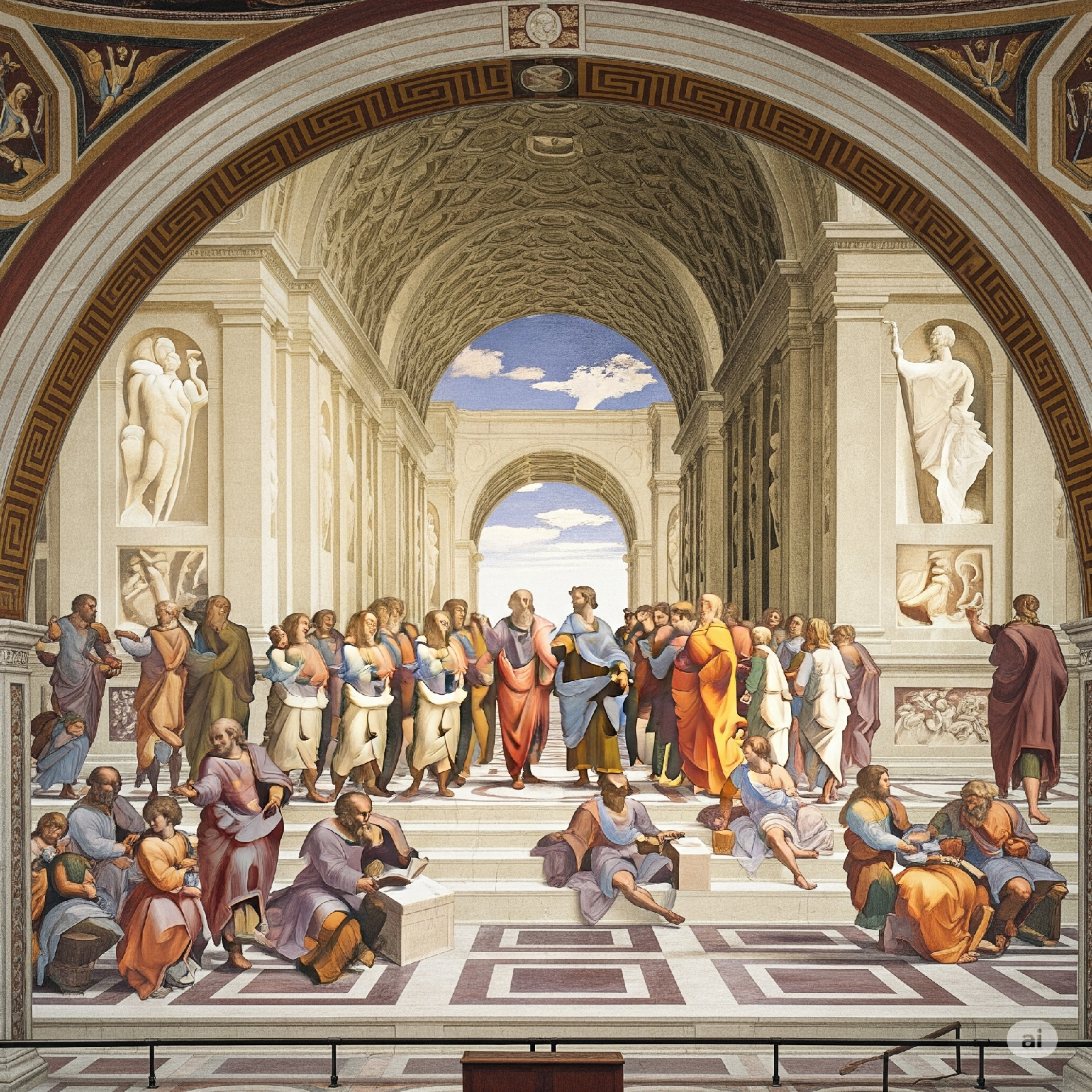
Here are some important details:
* Location: Vatican City, specifically within the Pope's private apartments (Stanza della Segnatura).
* Artist: Raphael (Raffaello Sanzio).
* Date: Painted between 1509 and 1511.
* Medium: Fresco.
* Significance:
* Masterpiece of the Renaissance: It's considered Raphael's masterpiece and a perfect embodiment of the classical spirit of the Renaissance, showcasing humanism and the revival of ancient knowledge.
* Allegory of Secular Knowledge/Philosophy: The fresco is a complex allegory representing philosophy and secular knowledge. It brings together the greatest mathematicians, philosophers, and scientists from classical antiquity, sharing ideas and learning from each other.
* Intellectual Program: It's part of a larger intellectual program in the Stanza della Segnatura, with each wall representing a different branch of knowledge: Theology (Disputa), Philosophy (School of Athens), Poetry (Parnassus), and Justice (Cardinal Virtues). Raphael's goal was to show the harmony between Christian and Greek philosophy, and the pursuit of universal truth.
* Depiction of Great Thinkers: The painting features a gathering of around 52 figures, representing various philosophical schools and historical periods. While some identifications are debated, key figures include:
* Plato and Aristotle (Center): These two central figures are the undisputed main subjects, positioned at the vanishing point of the fresco, drawing the viewer's eye. Their gestures symbolize their differing philosophies: Plato points upwards, referencing his Theory of Forms (a higher, unchanging reality), while Aristotle gestures horizontally towards the earth, emphasizing the study of the concrete, material world.
* Other Notable Figures (Commonly identified):
* Pythagoras (lower left): Associated with mathematics and the "harmony of the spheres."
* Euclid (lower left): Depicted teaching geometry to students.
* Ptolemy (lower right): Holding a terrestrial globe.
* Zoroaster (lower right): Holding a celestial sphere.
* Heraclitus: Often identified as a brooding figure, possibly a portrait of Michelangelo.
* Diogenes: Reclining on the steps.
* Raphael's Self-Portrait: Raphael himself is believed to be included among the figures on the far right, looking out at the viewer.
* Architectural Grandeur and Perspective: The setting is a magnificent, imagined classical basilica, believed to be based on Bramante's design for the new St. Peter's Basilica in Rome. Raphael masterfully uses one-point linear perspective to create a deep sense of space and draw attention to the central figures, with all lines converging between Plato and Aristotle.
* Humanism: The painting embodies the ideals of Renaissance Humanism by celebrating human intellect, the pursuit of knowledge, and the importance of classical antiquity. It shows a departure from medieval thought by valuing human understanding and reason.
Comments
Post a Comment